
Professional Education / Organs and tissues
Learn.Share.Advance
ABOi Lite Matching in KPD
Purpose
The ABOi Lite initiative aims to expand kidney transplant opportunities within the Kidney Paired Donation (KPD) program by enabling carefully selected ABO-incompatible matches using donor blood group subtyping and transplant candidate anti-A antibody testing.
This approach is designed to increase access to transplantation, particularly for blood group O and B transplant candidates by safely introducing an option to receive a “slightly” incompatible kidney transplant for blood group O and B candidates.
What is changing and how does it work?
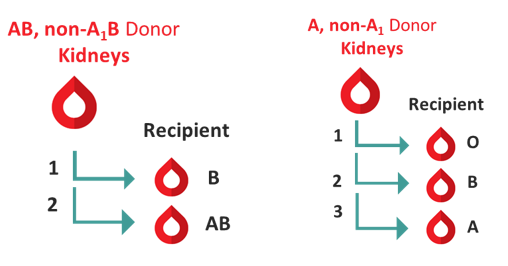
ABOi Lite allows blood group O and B transplant candidates to be matched with blood subgroup A non-A1 and AB non-A1B donors, where these matches were previously not considered.
Eligibility is based on the transplant candidate’s anti-A antibody levels meeting defined thresholds, enabling select ABO-incompatible matches within KPD.
How it works:
- Donor Subgrouping: All blood group A and AB donors are tested to determine their subgroup (A1 vs non-A1; A1B vs non-A1B). Only “A non-A1“and “AB non-A1B” donors are eligible. See diagrams 1 and 2 below.
- Transplant Candidate Testing: Candidates undergo anti-A antibody testing, with results interpreted using the provided standardized guidance.
- Eligibility Review: Programs assess transplant candidates based on antibody levels and clinical judgment.
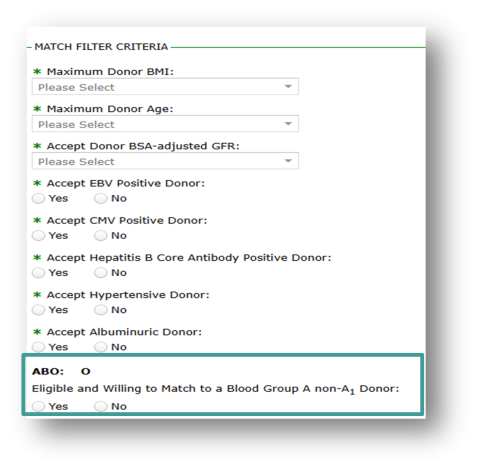
- Canadian Transplant Registry (CTR) Activation: Eligible transplant candidates can receive ABOi Lite matches during KPD match cycles by activating the ABOi Lite option found on the transplant candidate’s record.
Image
Rationale
Despite prioritization mechanisms within KPD, inequities in transplant access persist across blood groups.
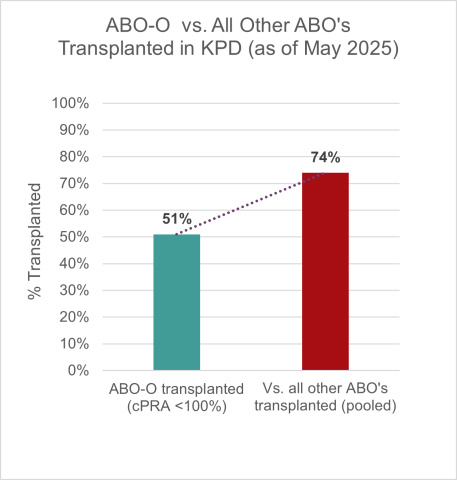
As of May 2025, 51% of blood group O candidates in KPD have received a transplant compared to 74% of non-O candidates, demonstrating lower transplant rates and fewer match opportunities for O candidates (graph 1).
Image
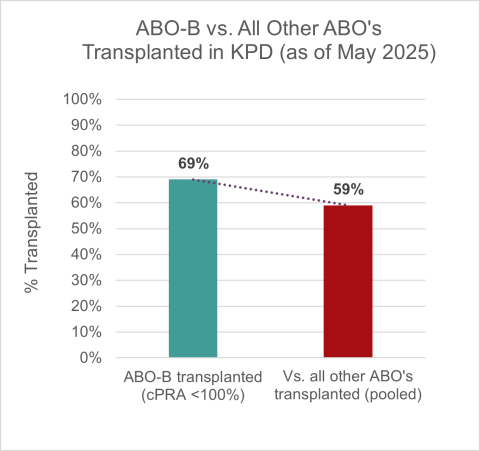
While blood group B candidates have higher transplant rates (69% vs 59% for non-B, graph 2), bringing in pairs with a blood group B transplant candidate and matching them with a blood group “A subgroup non-A1“ or blood group “AB subgroup non-A1B” donor can increase the number of overall pairs who receive a match in a Match Cycle.
Image
Program data shows:
- Lower transplant rates for O candidates compared to non-O candidates
- Underutilized potential of A and AB donor subgroups (non-A1 and non-A1B)
- Matching B transplant candidates to non-A1 or non-A1B donors can increase the number of pairs who receive a match in a given Match Cycle
ABOi Lite addresses these challenges by:
- Leveraging non-A1 and non-A1B donors to expand compatibility options for blood group O and B transplant candidates
- Enabling “slightly incompatible” but clinically acceptable matches under defined criteria
- Increasing total match combinations within each Match Cycle
What is the scope of the project?
In scope:
- Development of written clinical recommendations, including:
- Anti-A antibody testing methodologies & result interpretation guide
- Patient information and key elements to informed consent
- Donor subgroup testing (A1 vs non-A1; A1B vs non-A1B) integration into KPD processes
- ABOi Lite matching (algorithm) implementation within KPD Match Cycles
- Education and knowledge mobilization, including:
- National webinar(s)
- End-user job-specific education (LDN - coordinators, NHLAAC – lab directors, KTAC – transplant nephrologists)
- Standardized data collection and reporting, including:
- Outcomes of ABOi Lite transplants – Annual outcome survey (KPD)
- Monitoring rejection episodes and clinical performance – as they occur
- Ongoing reporting to LDN, NHLAAC, KTAC and ABOi Lite working group.
Out of scope:
-
Formal reporting infrastructure for anti-A antibody level testing results
- Outcome data where the candidate was not transplanted within KPD
Who is impacted by the change and what does it mean to them?
Transplant Physicians:
- Expanded matching options for difficult-to-match patients
- Requirement to assess eligibility for ABOi Lite based on clinical criteria
- Use of new guidance to interpret anti-A antibody testing results and risk
Transplant Coordinators:
- Incorporation of ABOi Lite discussions into patient education and consent
- Operational coordination of matches involving ABOi Lite
HLA Laboratories / Transfusion Medicine Labs:
-
Increased role in donor subgroup testing (A/AB subgrouping)
- Contribution to anti-A antibody testing and interpretation
Patients (Transplant and Donor Candidates):
- Clearer understanding of ABOi Lite through standardized information
- Leading to increased access to transplant opportunities
System / Program Level:
- Improved equity for blood group O and B candidates
- Better utilization of available donors
What are the expected implementation timelines?
ABOi Lite was launched on February 2, 2026, aligned with the February KPD match cycle.
The project is currently in an ongoing optimization and monitoring phase. A national working group meets bi-monthly to:
- Review operational processes and identify opportunities for improvement
- Discuss complex or illustrative cases
- Support consistent application across programs
This iterative approach ensures continuous refinement of processes while maintaining program safety and performance.
Project Document Repository
Project documentation:
- ABOi Lite Matching in KPD - Recommendations and Appendices
- Kidney Paired Donation: ABOi Lite Sample Tracking Form-Flow Cytometry
- Kidney Paired Donation: ABOi Lite Sample Tracking Form-Luminex Immunoassay
Open and save workbook in Excel Desktop app to retain automated functions.
Canadian Transplant Registry:
- See Reference Documents tab of the CTR. Note: User access is required, or documents can be requested through CTR support at transplantregistry@blood.ca.
Education
“ABOi Lite Matching in KPD” hosted by Dr. Michel Pâquet, transplant nephrologist and Medical Director of the Kidney Living Donation Program at CHUM, and Medical Advisor for Living Donation & Transplantation at Canadian Blood Services.
Presentation date: December 2, 2025, 60 minutes
The virtual meeting provides an overview of:
- the ABOi Lite process
- key implementation timelines
- sample shipping requirements.
- Supplemental testing presentations by Dr. Robert Liwski, Medical Director of the HLA Laboratory at the Queen Elizabeth II Health Sciences Centre Professor of Pathology at Dalhousie University and Co-Chair of the National Human Leukocyte Antigen Advisory Committee (NHLAAC) and Dr. Anne Halpin, Associate Professor in the Department of Laboratory Medicine and Pathology at the University of Alberta and Director of the Histocompatibility Laboratory at Alberta Precision Laboratories.
Click here to watch the presentation recording.
CTR Training
IMPORTANT: Prior to selecting “Yes” in the candidate’s CTR record, the transplant programs must ensure:
- The transplant candidate has been tested, and anti-A antibody levels are below threshold and stable.
- The clinician determined the transplant candidates is eligible to be matched in ABOi Lite, supported by test results and medical history.
- Key Elements of ABOi Lite have been provided and/or discussed with the transplant candidate and informed consent has been documented (as per local practice).
Image
Frequently Asked Questions
Where do I find information to help patients understand ABOi Lite matching?
Download the ABOi Lite Matching in KPD – Recommendations and Appendices found in the project documents section above and refer to Appendices 1A and 1B.
What kind of testing is necessary for participants in ABOi Lite?
Download the ABOi Lite Matching in KPD – Recommendations and Appendices found in the project documents section above and refer to Recommendation section 1.c and Appendices 4
How to get in touch
For questions about the project, please email the KPD team at kpd@blood.ca.
About Canadian Blood Services
Canadian Blood Services works with the Organ and Tissue Donation & Transplantation (OTDT) community to improve national system performance. We do this through coordination of interprovincial organ sharing policies and programs through the Canadian Transplant Registry, the development of leading practices, professional education, public awareness and data analysis and reporting.