
Professional Education / Organs and tissues
Learn.Share.Advance
Interprovincial Organ Sharing Liver Program (IPOS Liver)
Purpose
To establish a deceased donor liver Interprovincial Organ Sharing Program (IPOS Liver) that standardizes interprovincial sharing processes and improves transparency in eligibility criteria for IPOS Liver allocation criteria and transplant outcomes.
Rationale
Background
In 2006, Canada's liver transplant community discussed urgent status liver recipients, identifying the need for a national approach to interprovincial organ sharing
In 2010, the Canadian Liver Transplant Network (CLTN) engaged with Canadian Blood Services as a national collaborator and subject matter expert to support ongoing work toward more consistent national coordination.
Canadian Blood Services subsequently implemented the National Organ Waitlist (NOW) and supported the national “handshake agreement” through NOW processes and urgent status alerts, providing an initial foundation for standardized notification and coordination. Building on broader national progress in interprovincial organ sharing, Canadian Blood Services led a foundational Liver Listing and Allocation Forum in 2016, in collaboration with CLTN and the Canadian Society of Transplantation (CST). The forum focused on building a national consensus on key program design elements, including eligibility requirements for urgent listing and the frameworks for candidate matching, and ranking prioritization rules, Policies were drafted to support these discussions.
In 2017, policy development progressed into provincial approvals and signoffs, including both administrative and clinical endorsement from each province. Following a pause associated with the COVID-19 pandemic, engagement with the liver community resumed in 2024, with liver working groups and a project steering committee reestablished to refine the original policies based on working group feedback and implementation planning needs.
What is the scope of the project?
In scope:
The project will support the interprovincial sharing of deceased donor livers for defined urgent and highly specialized liver transplant candidates. The project includes the clinical criteria, business processes, Canadian Transplant Registry (CTR) application and Application Programming Interface functionality, standardized offering workflow, and outcome monitoring activities required to support national liver sharing.
The scope of the IPOS Liver project includes the interprovincial sharing of deceased donor livers for the following liver transplant candidates:
- Status 4F transplant candidates
- Status 3F transplant candidates
- Paediatric transplant candidates requiring a multivisceral transplant, such as liver, small bowel, stomach, colon, and pancreas (3LS)
- Paediatric transplant candidates less than or equal to 6 kg (3P)
AND
- Urgent notifications for paediatric transplant candidates < 6 kg
The scope also includes standardizing the process for offering livers when shared interprovincially, including the use of CTR functionality to produce an interprovincial allocation list, support the offer process, and record transplant outcomes.
The implementation will include the use of the CTR application and API to support the listing of liver transplant candidates and the recording of donor acceptance criteria. For candidates requiring a liver/small bowel transplant, the Model for End-stage Liver Disease (MELD)/Paediatric End-stage Liver Disease (PELD) score will be recorded in CTR.
CTR will also be used to support national tracking of liver imports, exports, and program outcomes to enable ongoing monitoring, reporting, and program evaluation.
Out of scope:
The following areas are out of scope for IPOS Liver project implementation:
- Living liver donation
- Deceased donor split liver allocation
- Urgent notifications for paediatric transplant candidates > 6 kg
- Adult transplant candidates requiring a multivisceral transplant, such as liver, small bowel, stomach, colon, and pancreas
- Transplant candidates with non-urgent status listings
- Import and export thresholds
These areas will not be included in the implementation scope and will not be supported through IPOS Liver functionality at this time.
Who is impacted by the change and what does it mean to them?
The IPOS Liver project implementation will impact clinical, operational, technical, and administrative stakeholders involved in interprovincial liver sharing. The nature of the change will vary by role, depending on each stakeholder’s involvement in candidate listing, donor offer review, allocation, transplant coordination, system, sharing and monitoring of post transplant outcome data.
Liver Surgeons
Liver surgeons will be impacted through the standardized interprovincial liver offering and acceptance process. They may need to review allocation information, assess donor offers in accordance with national sharing criteria, support timely acceptance decisions, and align clinical decision-making with the standardized IPOS Liver workflow.
Hepatologists
Hepatologists will be impacted through candidate identification, clinical eligibility assessment, and documentation requirements. They may support confirmation of candidate status, MELD/PELD information where applicable, and clinical information needed for listing and offer review.
Pre-Transplant Coordinators
Pre-transplant coordinators will experience workflow changes related to listing eligible liver transplant candidates, recording or validating donor acceptance criteria, ensuring required candidate information is complete in CTR, supporting offer review activities, and coordinating communications between clinical teams and organ donation organizations (ODOs).
Post-Transplant Coordinators
Post-transplant coordinators will be impacted by transplant outcome documentation and follow-up reporting requirements. They may support the recording of transplant outcomes, completion of outcome monitoring surveys, and collection of information needed for program evaluation.
Liver Transplant Program Managers
Program managers will be responsible for supporting local readiness, workflow adoption, staff awareness, training participation, policy and procedure alignment, and resource planning. They may also support issue escalation, implementation monitoring, and coordination across clinical and administrative teams.
ODO Coordinators
ODO coordinators will be impacted by standardized processes for interprovincial liver offers, including communication with transplant programs, coordination of donor information, offer sequencing, documentation of offer outcomes, and import/export tracking.
ODO Digital Departments
ODO digital teams will be impacted by technical and data exchange requirements related to CTR application and API use. This may include supporting local system readiness, API integration, data mapping, testing, troubleshooting, and coordination with CTR technical teams.
What is Changing and How Does it Work?
The IPOS Liver program will introduce a standardized national process for the interprovincial sharing of deceased donor livers for defined urgent and specific paediatric high priority liver transplant candidates and clarify how deceased donor livers are shared between provinces. The change will support fair and timely national access for medical status 4F and 3F (Fulminant status), paediatric candidates requiring liver & small bowels (3LS), and paediatric candidates weighing less than or equal to 6 kg (3P).
IPOS Liver will improve national access for paediatric liver transplant candidates requiring liver/small bowel transplant and paediatric liver transplant candidates less than or equal to 6 kg. The addition of the 3LS status will ensure that paediatric liver/small bowel candidates have access to a national donor pool while reserving the use of the 3F medical status for fulminant status candidates only.
Eligible liver transplant candidates will be listed in the CTR, including required clinical information and donor acceptance criteria. Where applicable, MELD/PELD scores will be recorded in CTR for candidates requiring liver and small bowel transplant. CTR will simplify the interprovincial allocation process by producing a ranked allocation list of matching candidates, making and managing offers, and recording decline reasons. CTR will also be used to track imports, exports, transplant outcomes, and program outcomes. Outcome information will support national monitoring, reporting, program evaluation, and future improvements to the IPOS Liver program.
What are the expected implementation timelines?
In the case of a phased implementation:
Image
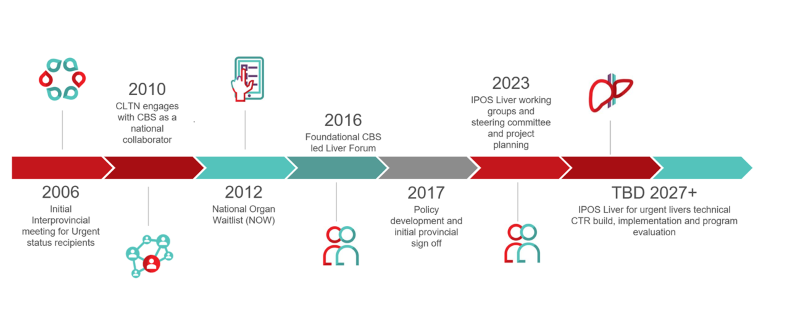
In 2026, the IPOS Liver project implementation moved into a phased delivery approach. Phase 1 is focused on process and policy implementation using existing NOW functionality for listing and urgent status notifications, supported by CTR customer support, workflow and end-user training, and national monitoring of transplant outcomes through surveys and program evaluation. Findings from Phase 1 will inform requirements for the subsequent technical implementation in Phase 2, including CTR-enabled allocation functionality to generate ranked allocation lists for deceased donor livers, with timeline of implementation still to be determined. Implementation timeline to come following policy approval by steering committee and provincial partners, which is expected by the end of 2026.
If a full technical implementation is decided by Steering committee:
In 2026, the IPOS Liver project implementation advanced toward a full technical implementation approach. The implementation will include the required process, policy, workflow, training, monitoring, and technical components needed to support national liver sharing through the IPOS Liver program.
This includes use of existing NOW functionality for listing and urgent status notifications, supported by CTR customer support, workflow and end-user training, and national monitoring of transplant outcomes through surveys and program evaluation. These activities will support readiness for the full technical implementation, including CTR-enabled allocation functionality to generate ranked allocation lists for deceased donor livers, with timeline of implementation still to be determined. Implementation timeline to come following policy approval by the steering committee and provincial partners, which is expected by the end of 2026.
Frequently asked questions
What are the IPOS Liver program policies? Coming soon:
- CTR.20.001 Recipient Eligibility
-
CTR.20.002 Matching and Ranking
-
CTR.20.003 Requirement to Offer
-
CTR.20.004 Interprovincial Balancing: Imports and Exports
-
CTR.20.005 Transplant Outcome Monitoring
What is the purpose of CTR.20.001 Recipient Eligibility Policy?
CTR.20.001 defines the eligibility criteria for liver transplant candidates who may be considered for interprovincial liver sharing through the IPOS Liver program. This policy supports consistent identification and listing of eligible candidates across participating provinces and transplant programs.
What is the purpose of CTR.20.002 Matching and Ranking Policy?
CTR.20.002 defines how eligible IPOS Liver transplant candidates are matched and ranked for interprovincial liver offers. This policy supports consistent application of matching criteria, ranking rules, and allocation logic when a deceased donor liver is available for sharing.
What is the purpose of CTR.20.003 Requirement to Offer Policy?
CTR.20.003 defines the procedures that Organ Donation Organizations and transplant programs must follow when proposing, managing, and responding to interprovincial liver offers. This policy supports standardized offer communication, documentation, and decision-making requirements.
What is the purpose of CTR.20.004 Interprovincial Balancing of Exports and Imports Policy?
CTR.20.004 defines the process for tracking the number of livers shared between provinces. This policy supports transparency in interprovincial liver sharing activity by monitoring imports and exports across participating jurisdictions.
What is the purpose of CTR.20.005 Transplant Outcome Monitoring Policy?
CTR.20.005 defines the requirements and responsibilities for annual monitoring of transplant outcomes for recipients transplanted through the IPOS Liver program. This policy supports consistent outcome data collection, reporting, and program evaluation.
What recipients are eligible to participate in the IPOS Liver program?
- 4F (Paediatric <18 and Adults): In intensive care requiring mechanical ventilation for fulminant liver failure, including primary nonfunction of a graft; without liver transplantation, death is considered imminent.
- 3F (Paediatric <18 and Adults): In intensive or equivalent care facility for fulminant liver failure but not on mechanical support, who fulfills the King’s College criteria for high risk of mortality without liver transplantation.
- Paediatric multivisceral candidates: Paediatric candidates requiring a combined liver/small bowel or other multivisceral transplant.
- Paediatric candidates weighing ≤ 6 kg
What is the definition of fulminant hepatic failure (4F and 3F candidates)?
Fulminant hepatic failure, also known as acute liver failure, is the sudden and severe loss of liver function. It occurs rapidly, usually within days or weeks—in a person with no prior history of liver disease. It is a life-threatening medical emergency, for many cases, especially when spontaneous recovery is unlikely, a liver transplant is the only life-saving option.
How is CTR used in the IPOS Liver program implementation?
CTR will support key steps in the IPOS Liver workflow. This includes listing IPOS Liver transplant candidates, matching candidates based on ABO and donor acceptance criteria, supporting liver offers through IPOS Liver program job aids, off-listing recipients after transplant, and supporting post-transplant data collection.
How will IPOS Liver transplant candidates be listed?
Eligible candidates will be listed in CTR in accordance with the CTR.20.001 Recipient Eligibility Policy, which defines the approved IPOS Liver eligibility criteria for interprovincial liver sharing. Required clinical information and donor acceptance criteria will be entered and maintained to support interprovincial matching and offer decisions.
When will a paediatric 3LS lose eligibility from the IPOS Liver program?
When they are less than 18 years of age (until 12 AM Pacific time).
When will a paediatric 3P lose eligibility from the IPOS Liver program?
As soon as they are greater than 6.0 kg.
How will post-transplant data be collected?
Post-transplant data will be collected through transplant outcome monitoring processes, including a post-transplant data collection survey tool. This information will support national monitoring, reporting, program evaluation, and future improvements.
What benefits and outcomes are expected from the IPOS Liver program?
IPOS Liver is expected to promote fair and timely national access for eligible liver transplant candidates facing urgent medical conditions or elevated mortality risk. It is also expected to support appropriate use of 3F medical status, improve national access for eligible paediatric candidates, increase transparency in allocation and offer decision-making, and support standardized monitoring of transplant outcomes.
How will the benefits and outcomes be measured?
Benefits and outcomes will be measured through national monitoring of transplant activity and outcomes. Measures may include the number of candidates transplanted through national access compared to local access, the number of candidates who die on the waitlist or improve and no longer require transplant, offer decline reasons, allocations not run, offers not made, and transplant outcome monitoring survey results.
Reporting is expected at 3 months, 6 months, and annually post-go-live for selected access measures. Transplant outcome monitoring is expected to be reported 12 months after program launch.
How will the IPOS Liver program increase transparency?
The IPOS Liver program will increase transparency by standardizing the allocation process, offer tracking, and decision documentation at the time of offer. This will help participating programs understand how eligible candidates are identified, how offers are made, and how offer decisions are recorded for Status 4F, Status 3F, liver-small bowel, and paediatric candidates less than or equal to 6 kg.
How will the IPOS Liver program support national access for paediatric candidates?
The IPOS Liver program will support national access for paediatric liver transplant candidates who meet defined eligibility criteria, including candidates requiring liver/small bowel transplant and candidates less than or equal to 6 kg . This supports access beyond local availability for this group of paediatric candidates.
How will the IPOS Liver program be evaluated?
The IPOS Liver program will be evaluated to assess the effectiveness of the implementation, the extent to which the process is working as intended, the benefits being realized, and early outcomes across participating provinces and transplant programs.
Evaluation findings will be used to identify what is working well, where additional support or clarification may be required, and what improvements should be considered for future program enhancements.
Who will participate in the program evaluation?
Stakeholder groups participating in the evaluation may include transplant program administrators, organ donation organization administrators, clinicians, donor coordinators, and recipient coordinators.
What methods will be used to evaluate the IPOS Liver program?
Evaluation methods will include surveys and review of feedback received through email, customer support channels, and implementation or program meetings. Feedback will be used to identify operational issues, training needs, process improvements, and opportunities to strengthen the program.
What approvals or sign-offs are required to launch the IPOS Liver program?
Provincial clinical and administrative sign-offs will be required on the current draft IPOS Liver project materials in 2027. These sign-offs will confirm provincial review and agreement with the proposed clinical, operational, policy, and administrative components of the implementation.
What is the difference between clinical and administrative sign-off?
Clinical sign-off confirms review and alignment with the proposed clinical criteria, workflows, and transplant program requirements. Administrative sign-off confirms review and alignment with operational, policy, resource, governance, and implementation considerations.
How were external stakeholders involved in shaping the IPOS Liver project?
External stakeholders were engaged throughout the development of the IPOS Liver project to help shape the project approach, process design, and policy requirements. This included input through the Implementation Steering Committee, working group meetings, provincial impact assessments, and targeted meetings with surgeons and administrators on policy topics and in aim to identify policy/process improvement opportunities.
These activities helped identify jurisdictional considerations, clarify operational impacts, validate proposed workflows, and inform process improvements and policy requirements.
What external committees and working groups helped shape the project?
The IPOS Liver project was shaped through external engagement with the Implementation Steering Committee, working group meetings, provincial impact assessments, and targeted surgeon and administrator meetings. These forums supported discussion of process improvements, operational impacts, clinical considerations, and policy requirements.
How will successful launch be measured?
Successful launch will be measured by whether participating provinces have adopted and are applying the approved interprovincial liver sharing policies, whether standardized workflows are being used consistently, and whether required data on listings, offers, imports, exports, and outcomes is submitted completely and on time.
Success will also depend on active participation from transplant programs and ODOs, stakeholder feedback showing improved clarity and collaboration, and documented lessons learned to support future CTR technical functionality and program improvements.
The criteria for successful launch include:
- Policy implementation
- Standardized workflows
- Data collection and reporting
- Program participation
- Stakeholder feedback
- Technical readiness and future enhancements
Together, these criteria will help determine whether IPOS Liver has been successfully adopted and is operating as intended across participating provinces and transplant programs.
How will policy implementation be assessed?
Policy implementation will be assessed by confirming that all participating provinces have adopted and are applying the approved interprovincial liver sharing policies.
How will standardized workflows be assessed?
Standardized workflows will be assessed by reviewing whether participating programs are consistently applying the agreed-upon processes for identifying eligible candidates, offering shared livers, documenting decisions, and tracking interprovincial liver sharing activity.
How will data collection and reporting be assessed?
Data collection and reporting will be assessed by reviewing whether required data on listings, offers, imports, exports, transplant outcomes, and program outcomes is submitted completely and in a timely manner through the agreed-upon tracking and reporting process.
How will stakeholder feedback be assessed?
Stakeholder feedback will be assessed through surveys and feedback received by email, customer support channels, and implementation or program meetings. Feedback will be reviewed to determine whether stakeholders experience improved clarity, collaboration, consistency, and feasibility in the interprovincial liver sharing process.
How to get in touch
For questions about the project, please email the IPOS Liver team at ipos.programs@blood.ca
About Canadian Blood Services
Canadian Blood Services works with the Organ and Tissue Donation & Transplantation (OTDT) community to improve national system performance. We do this through coordination of interprovincial organ sharing policies and programs through the Canadian Transplant Registry, the development of leading practices, professional education, public awareness and data analysis and reporting.