If you have a specific question that is not answered by the information on this page or blood.ca, please contact your Canadian Blood Services Hospital Liaison Specialist.

Professional Education / Transfusion
Learn.Share.Advance
Uniform labelling
Authors: Jon Fawcett, BSc., MLT; Susan White, MLT; Jennifer Stepien, MLT
Target audience: Hospital staff working in transfusion medicine labs or Laboratory Information System (LIS) Specialists
Publication date: May 5, 2026
Canadian guidelines for the uniform labelling of blood and blood components using ISBT 128
Labelling of blood and blood components distributed by Canadian Blood Services and Héma-Québec aligns with the Information Standard for Blood and Transplant (ISBT) 128 Standard published by the International Council for Commonality in Blood Banking Automation (ICCBBA). Canadian Blood Services, in collaboration with Héma-Québec, developed The Canadian Guidelines for the Uniform Labelling of Blood and Blood Components Using ISBT 128 to assist with the use of ISBT 128 labelling for Canadian Blood Services and Héma-Québec. This document describes the standard policies adopted for use by Canadian Blood Services and Héma-Québec and is intended to be used in conjunction with the ISBT 128 Standard: Technical Specification, which is the definitive source describing ISBT 128 and should be consulted when implementing and using ISBT 128.
To read the guidelines, please click the red button below.
The Canadian Guidelines for the Uniform Labelling of Blood and Blood Components Using ISBT 128
For further information and resources regarding ISBT 128, or to access the ISBT 128 Standard: Technical Specification, visit iccbba.org. Access to ISBT 128 databases is provided to facilities that register with ICCBBA and updates will be made available to facilities that maintain their registration through payment of an annual license fee.
Frequently asked questions
Below are answers to frequently asked questions regarding ISBT 128 Standards and The Canadian Guidelines for the Uniform Labelling of Blood and Blood Components Using ISBT 128. If you have a specific question that is not answered by the information on this page or blood.ca, please contact your Canadian Blood Services Hospital Liaison Specialist.
1. I have a new LIS and need a list of Canadian Blood Services codes, where can I find them?
The list of most recent component codes can be found on our website on the Label Format and Material page.
2. Where can I find codes for components from Canadian Blood Services that do not have ISBT component codes in our LIS system?
If the component codes cannot be found on the Label Format and Material page, then refer to the customer letter library, which is searchable by both keyword and year. If a component is newer than our latest Product Code report run date, then refer to the product announcement customer letter.
3. Does Canadian Blood Services use ISBT special attribute codes on donor units?
Canadian Blood Services uses data structures as defined by ISBT for the various attributes (e.g., Leukoreduction, Low Volume or Irradiation). Attributes are an inherent part of the ISBT 128 component code. Any applicable information is included in the component text on the label.
Although not attributes, CMV-, IgA Def, and phenotype antigen information would be contained in the special testing barcode as applicable. More information can be found in The Canadian Guidelines for the Uniform Labelling of Blood and Blood Components Using ISBT 128
4. Where can I find information on secondary labelling requirements for blood components and products (e.g., adhesive, ink, etc.)?
Questions about label adhesives or inks typically relate to concerns about the risk of these products leaching into the component through the label and blood bag. Our Label Adhesive webpage discusses CSA Z902 standards in play. CBS uses Food and Drug Agency standard U.S. FDA 21 CFR 175.105 to ensure inks and adhesives are suitable for blood product labeling.
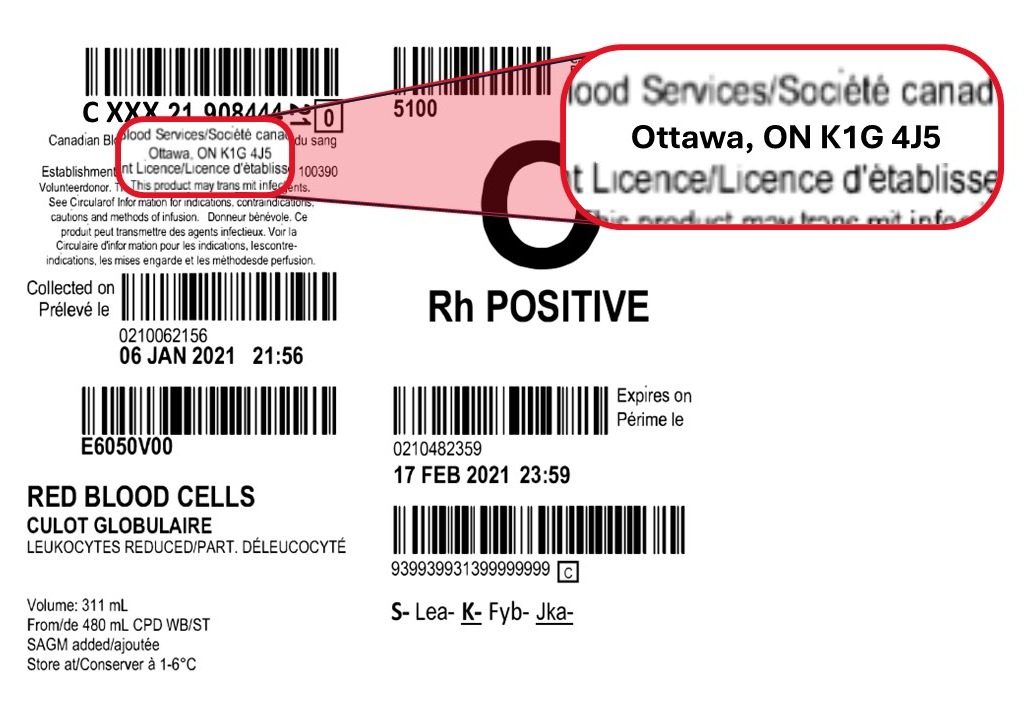
5. Why do all Canadian Blood Services components have a label with an Ottawa address?
All components produced by Canadian Blood Services are labelled with an Ottawa address because the location is linked to the establishment license (Figure 1).
Image
6. Is the unique donation number always used for units from international suppliers?
Canadian Blood Services will endeavor to use the original donation number for imported units. If an international unit has an incompatible donation number format (e.g., too few characters), then one conforming to the ISBT 128 standards will be assigned. Canadian Blood Services will not over label a foreign supplied unit; a tag(s) will be employed instead.
7. Are generic component codes used for units from international suppliers (e.g., American Red Cross)?
Hospitals have the discretion to use the generic international component code or the code used by the original manufacturer printed on the end label. International component codes were introduced via Canadian Blood Services’ customer letters: 2022-16, 2023-02 and attachment 1.
Using a generic international code rather than the original manufacturer’s code saves both the hospital and Canadian Blood Services the time needed to add new component codes to their LIS at the time of receiving imported units. If the international component code is ISBT 128 compliant and in the Canadian Blood Services system, then the original code will be used, unless the unit is rare. A generic international component code will always be used when receiving rare RBC units from an international supplier in case the unit(s) goes unused and are frozen later. For units that are not ISBT 128 compatible or if the component code is unavailable in our LIS (e.g., eProgesa), Canadian Blood Services will use the generic international component code. Canadian Blood Services issued packing slips will show the international component code when international component codes are used, however, the actual unit will show the original manufacturer’s product code.
8. Where can I find a list of Héma-Québec facility codes?
Hema-Quebec and American Red Cross facility codes can be found with the FACILITY/SITE CODES list on our Label and Format and Material webpage. This list is regularly reviewed.
9. Where can I find a list of antigen values used at Canadian Blood Services?
For a list of antigen values used by Canadian Blood Services, please refer to both the list of the most recent component codes on the Label Format and Material page and the ICCBBA website. Canadian Blood Services follows Data Structure 012 for Special Testing – Red Blood Cell Antigens labeling as characterized in the technical specifications section of the International Council for Commonality in Blood Banking Automation (ICCBBA) website. Contact your local HLS if you cannot find the antigen value you’re seeking.
10. Does Canadian Blood Services have an ISBT component code for thawed plasma?
No, Canadian Blood Services does not provide an ISBT code for thawed plasma components. Canadian Blood Services provides ISBT component codes for the state in which they issue a component to a hospital (e.g., frozen plasma). Hospitals must source their own appropriate codes from the International Council for Commonality in Blood Banking Automation (ICCBBA) for components that are transformed or further manufactured at a hospital site.
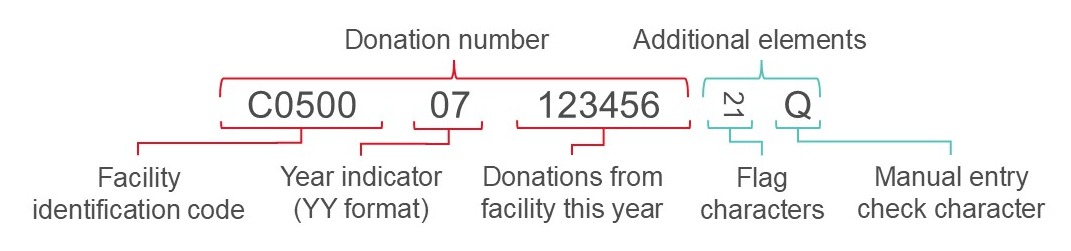
11. What do the sideways numbers on a label mean?
The digits printed at 90 degrees to the rest of the donation number are flag characters. Flag characters are used in process control by the blood operator. They are not part of the 13-digit donation number. The flag number will change depending upon the blood component’s stage of production and where it is printed.
Flag character examples:
- Donation Number Label = 20
- Label on back of units = 20
- Pool Number Label = 20
- End label = 21
- End label modified = 22 E.g.: irradiation
- Packing slip = 00
Image
Contact your hospital liaison specialist
Additional resources
Below are additional resources to assist with using ISBT 128 standards.
Suggested citation
Fawcett J White S, and Stepien J. Uniform labelling. [Internet]. Ottawa: Canadian Blood Services, 2026 [cited YYYY MM DD]. Available from: https://professionaleducation.blood.ca
If you have questions or suggestions for improvement, please contact us through the Feedback form.