
Professional Education / Transfusion
Learn.Share.Advance
“Donating for the future”: Reflections from a presentation on diversity in the donor base
February 6, 2026
Abby Wolfe

This post features excerpts from an AABB News article written by Leah Lawrence which originally appeared in AABB News Magazine in January 2026. The full article, Adaptive Recruitment Strategies Important for Successful Donor Pool Expansion, is available on the AABB website.
As leading experts in transfusion medicine and blood research topics, members of Canadian Blood Services’ research team regularly engage with other blood operators and research organizations around the globe to mobilize knowledge that can strengthen and inform blood systems.
Recently, Canadian Blood Services’ medical director for the donation policy and studies team, Mindy Goldman, accepted an invitation to present at the 2025 Annual Meeting hosted by AABB – the Association for the Advancement of Blood and Biotherapies. Dr. Goldman’s presentation was included in a section of the agenda titled: Donating for the Future: Bridging Generations and Communities for a Stronger Blood Supply.
In a post-presentation interview with AABB, Dr. Goldman emphasized the importance of racial and ethnic diversity in the donor base:
“One of the struggles the blood collection community has had in recent years has been matching the donors we recruit to the needs of the diverse patients we serve... We have a diverse general population in Canada, and it is getting more diverse all the time, but we have to work to make sure we recruit these diverse groups as donors.”
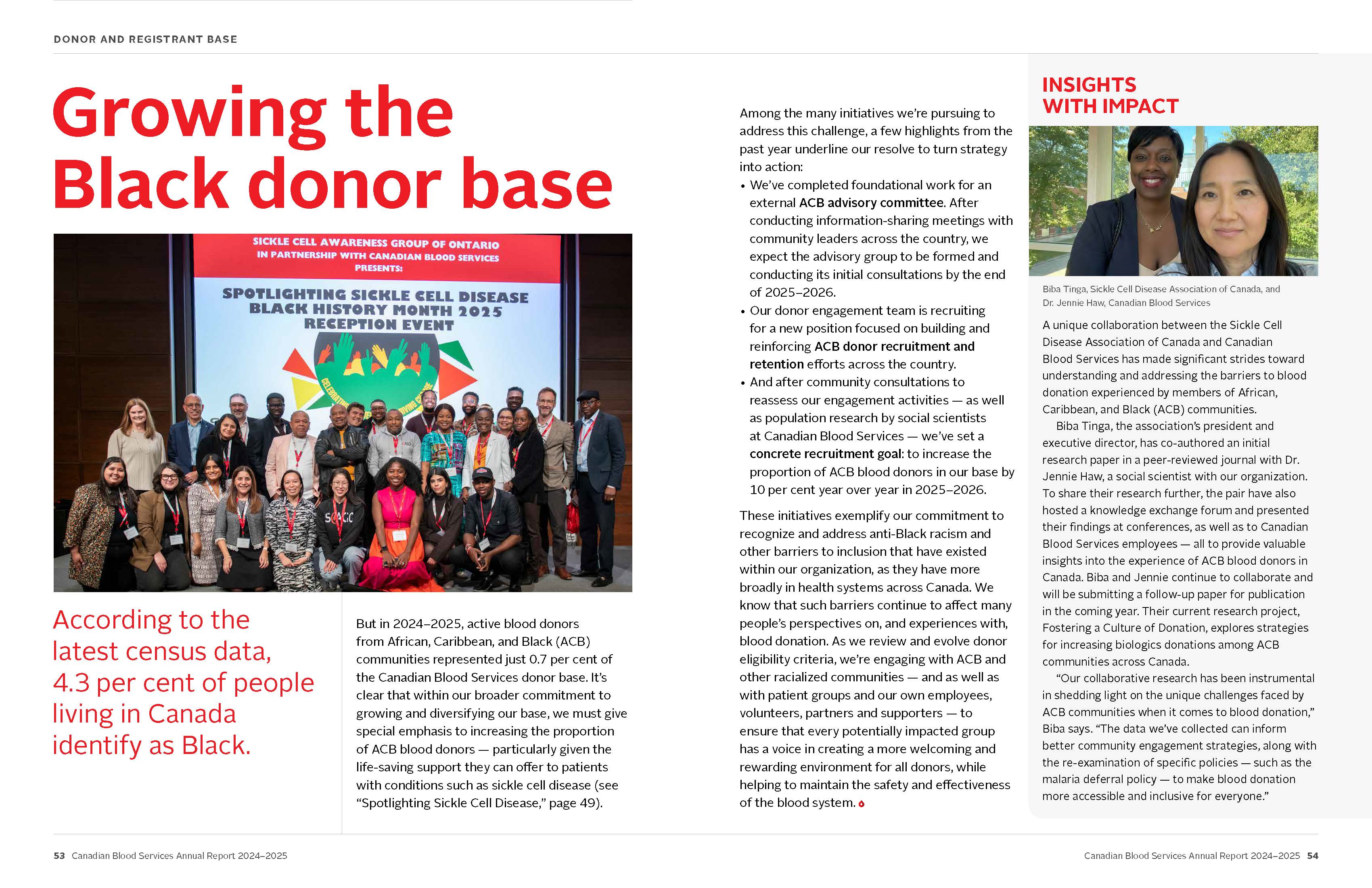
According to donor demographics reported in Canadian Blood Services’ most recent Surveilance Report, less than 1% of all whole blood donors in Canada self-identify as Black while 74% self-identify as White. At the same time, people from African, Caribbean, and Black communities may be uniquely positioned to help save lives through donation as patients with complex and ongoing transfusion needs–including people living with sickle cell disease (SCD)–require a high volume of blood products that are best matched when coming from donors of similar ethnic backgrounds. Increasing racial and ethnic diversity may also help identify rare blood donors, so the need for diversity in the blood system is growing.
As an example, Dr. Goldman’s presentation referenced research published in the peer-reviewed journal Transfusion that demonstrated how the need for red blood cells in the treatment of SCD has increased substantially over 15 years. In one graph, the data demonstrated how the total red cell units for transfusion and red cell exchange increased from approximately 300 in 2006 to 3000 in 2021 at a single Ottawa-based hospital.
In her post-presentation interview, Dr. Goldman described some of the efforts in-progress:
“From the operational side we are changing marketing and doing social science research with community members to explore barriers and better enable donations among diverse groups...”
Her presentation also acknowledged how existing eligibility criteria associated with malaria-endemic countries can be one of the barriers preventing some African, Caribbean and Black community members from donating. Currently, prospective donors who have spent at least six months in the last three years living in an area where malaria is endemic are not able to donate whole blood or platelets for three years; while having had malaria means you are unable to donate whole blood or platelet donation even after recovery.
Multidisciplinary teams at Canadian Blood Services are looking into ways to increase racial and ethnic diversity in the donor base and building relationships with communities most impacted. This includes investigations into selective malaria testing strategies that could potentially reduce deferral timelines for prospective donors that are ineligible for whole blood or platelet donations under the current criteria.
Related research activities have been focused around three main areas to date:
- Epidemiology: Associate director of epidemiology and surveillance Dr. Sheila O’Brien and team members have considered a risk-based decision making framework and analyzed donor demographics to understand the categories of prospective donors that are most affected by the current eligibility criteria. This knowledge provides a basis of understanding about the potential impact to the donor base that could be expected if nucleic acid tests (NAT) are approved for implementation.
- Testing: Director of medical microbiology Dr. Steve Drews and members of the Surveillance and Discovery Laboratory team are applying their expertise to study NAT sensitivity and validate how it may perform in the Canadian Blood Services context. These details will inform future implementation if the test is approved for use in blood donation testing.
- Social science: Within the donation policy and studies team, scientist Dr. Jennie Haw and collaborators continue to apply community-based research approaches and work closely with affected communities. Together, they are building understanding of the barriers and facilitators that influence donation, and generating knowledge that can inform how changes in donor recruitment, retention, screening and testing can be communicated in the most effective ways to support engagement.
- For an example, see the publication: Sickle cell disease and the need for blood: Barriers to donation for African, Caribbean, and Black young adults in Canada.
Dr. Goldman summarized in her interview comments:
“Recruiting donors depends on gaining trust in the community, and if a friend or community member hears someone was deferred for three years, or permanently deferred that discourages others from ever coming in.
If our proposed changes are approved by our regulator, Health Canada, we would have a three-month deferral after residency, like we do for short-term travelers, and a six-month deferral for a history of malaria. After these deferral periods, these donors would be eligible but have a NAT test done.”
To read Dr. Goldman’s biography and meet the other staff scientists whose expertise is contributing to this work, see
To review donor eligibility criteria and malaria, visit
Canadian Blood Services – Driving world-class innovation
Through discovery, development and applied research, Canadian Blood Services drives world-class innovation in blood transfusion, cellular therapy and transplantation—bringing clarity and insight to an increasingly complex healthcare future. Our dedicated research team and extended network of partners engage in exploratory and applied research to create new knowledge, inform and enhance best practices, contribute to the development of new services and technologies, and build capacity through training and collaboration. Find out more about our research impact.
The opinions reflected in this post are those of the author and do not necessarily reflect the opinions of Canadian Blood Services nor do they reflect the views of Health Canada or any other funding agency.